How To Break The Toxic Cycle Of Productivity And Ultimately Find Balance
Jessica Modad | OCT 11, 2022
productivity
How To Break The Toxic Cycle Of Productivity And Ultimately Find Balance
Jessica Modad | OCT 11, 2022
If you’re a driven leader or self-proclaimed “A type personality,” you constantly push yourself to hit new goals, produce more, and become more efficient. Here’s the kicker, you probably don’t realize that your drive to succeed can slide into toxic productivity. Next time, stop and notice when your desire to get things done is extreme; you could be headed down a slippery slope.
Know that you are not alone and there’s a way out of the toxic productivity cycle. Often, I see clients with a challenge in front of them, and their first impulse is to change or do everything at once. Sound familiar? A more sustainable approach would be sitting with the problem, thinking, reflecting, and brainstorming your options. And don’t underestimate tools like rest, time outs, and unscheduled space to do nothing, which can also ironically skyrocket productivity.
Toxic productivity is not sustainable in the long run. It's important to take care of yourself and find a healthy balance between work and life. Learn more about how to overcome it.
If you Google “work-life balance,” you will see many reasons. Some people look at it as a modern-day word for “workaholism.” The first thing is that “doing” often feels more comfortable than “not doing,” Psychology Today. The pandemic seemed to encourage toxic productivity (remember all those IG feeds filled with sourdough starters?!). The toxicity can be challenging to spot because overwork is often cast in a positive light. Time to change your mindset. It’s okay to rest, turn off, unplug and stop worrying about what you “should” do.
Just look at hustle culture, which glorifies the day-in, day-out grind of working relentlessly to achieve success. Business moguls like Elon Musk tweet, "nobody ever changed the world on 40 hours a week,” while social media influencers post videos and photos of idealized, productive routines. With all that noise, it’s easy to feel guilty if you’re not rising and grinding like everyone else.
Research shows that this can significantly impact work-family conflict and mental health. When you push yourself too hard for too long, it’s easy to measure your self-worth by how much you can get done.
Productivity is good, but it’s sometimes hard to recognize when your productivity becomes toxic. Picture this: You are trying to get a promotion at work. You’ve been working to exceed expectations for the past three months and show your commitment to your company.
Because you’ve been so focused on your work, you’ve let some things fall by the wayside. You started missing your daily walks and began canceling plans with friends to work an extra hour or two. You forget to eat because you're trying to fit in more tasks. It seems small, but fast forward three months from now, and you’re exhausted, overwhelmed, and on the verge of burnout because you have been focused on being the“best.”
Here are some red flags of toxic productivity:
Here’s where the rubber meets the road. It’s all about you, and it's all about choices!
First, let's focus on what’s important, not just what’s urgent.
Schedule important tasks, and give yourself more time than you need. Research shows that scheduling is the most impactful element of getting things done. Isolate the most impactful aspects of crucial tasks, and acknowledge that larger tasks require incremental progress.
A fantastic way to separate tasks and prioritize your tasks is to use the Eisenhower Matrix. The matrix goes by names, including the Eisenhower Box, Time Management Matrix, and Urgent / Important Matrix. The matrix is instrumental in placing tasks into four categories: Do, Schedule, Delegate, and Delete.
The matrix is simple: on one axis, you have importance, and on the other, you have urgency. This results in four categories:
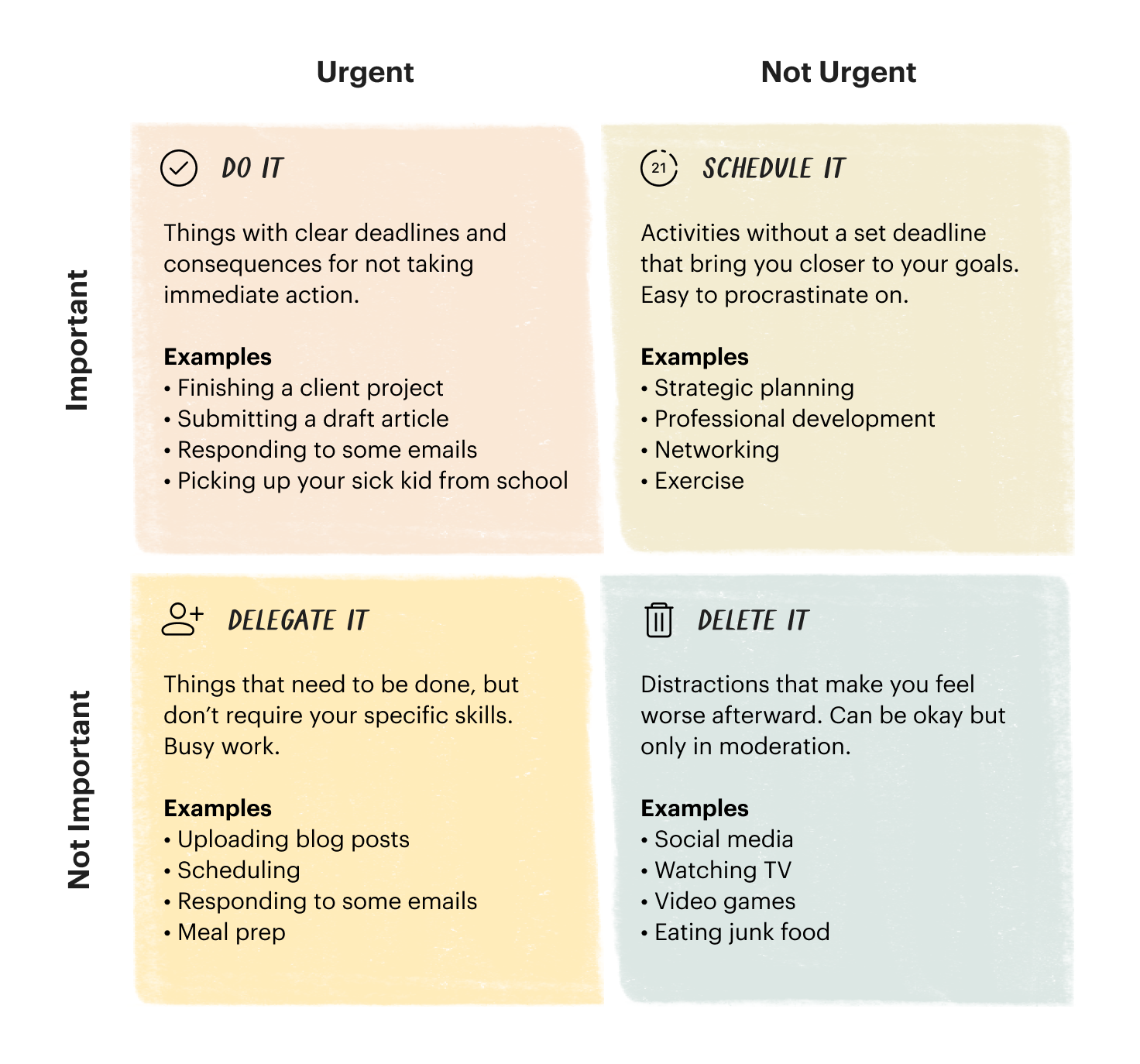
Staying above the line ensures that you’re making progress on things that are meaningful to you, personally and professionally.
Self-awareness
Self-awareness has several benefits. It can help you manage emotions, set boundaries, and make better decisions. It can also help you be more productive. The Eurich group has researched the nature of self-awareness. Their research indicates that when we look inward, we can clarify our values, thoughts, feelings, behaviors, strengths, and weaknesses. We can recognize the effect that we have on others. Eurich's research finds that people with self-awareness are happier and have better relationships. They also experience a sense of personal and social control and higher job satisfaction.
Here are some examples of common benefits of self-awareness:
Start defining work boundaries.
If you're struggling to stay productive and avoid burnout while working remotely, consider setting firmer boundaries between your work and non-work hours.
So shut the door, turn on, do not disturb, time block your day, and plan a time to end your work day.
Examples of boundaries include the following:
After setting these boundaries, ask: “Did I feel more or less productive at work? Am I more or less refreshed in my partner, friend, or parent role?”
You can always return to your old ways, but frequently, people discover the tasks or mindsets that no longer serve them.
As you experiment with hard and soft boundaries, remember that the process is fluid. The focus is to gain a deeper understanding of what you want rather than what is handed to you by a boss, customer, partner, kid, friend, or society. When you step back, reflect, and evaluate your desires, you’ll discover that boundaries don’t limit you; they give you the space to create the life you want to live.
Finally, Schedule time to do nothing.
“The most valuable time every day is the time I spend doing nothing.” Jeff Bezos, the well-known Amazon founder, said this in his book “Invent & Wander: the collected writings of Jeff Bezos.”
The big ideas often come when productive people step away from their work. Taking a break and opting for a change of scenery can bring clarity when they return to their lives.
When the most productive people step away from their busy lives, new people and experiences have room to show up. The daily grind can lead to dissatisfaction, and a hopeless feeling like nothing is getting done.
Now is the time to oppose the most common theory that "productivity is getting more things done." Block out space to do nothing in your calendar and protect that space.
.
Instead of “rising and grinding” each day, approach your work with the balance you need to thrive. Let’s get this party started!
Jessica Modad | OCT 11, 2022
Share this blog post